BES Tracker

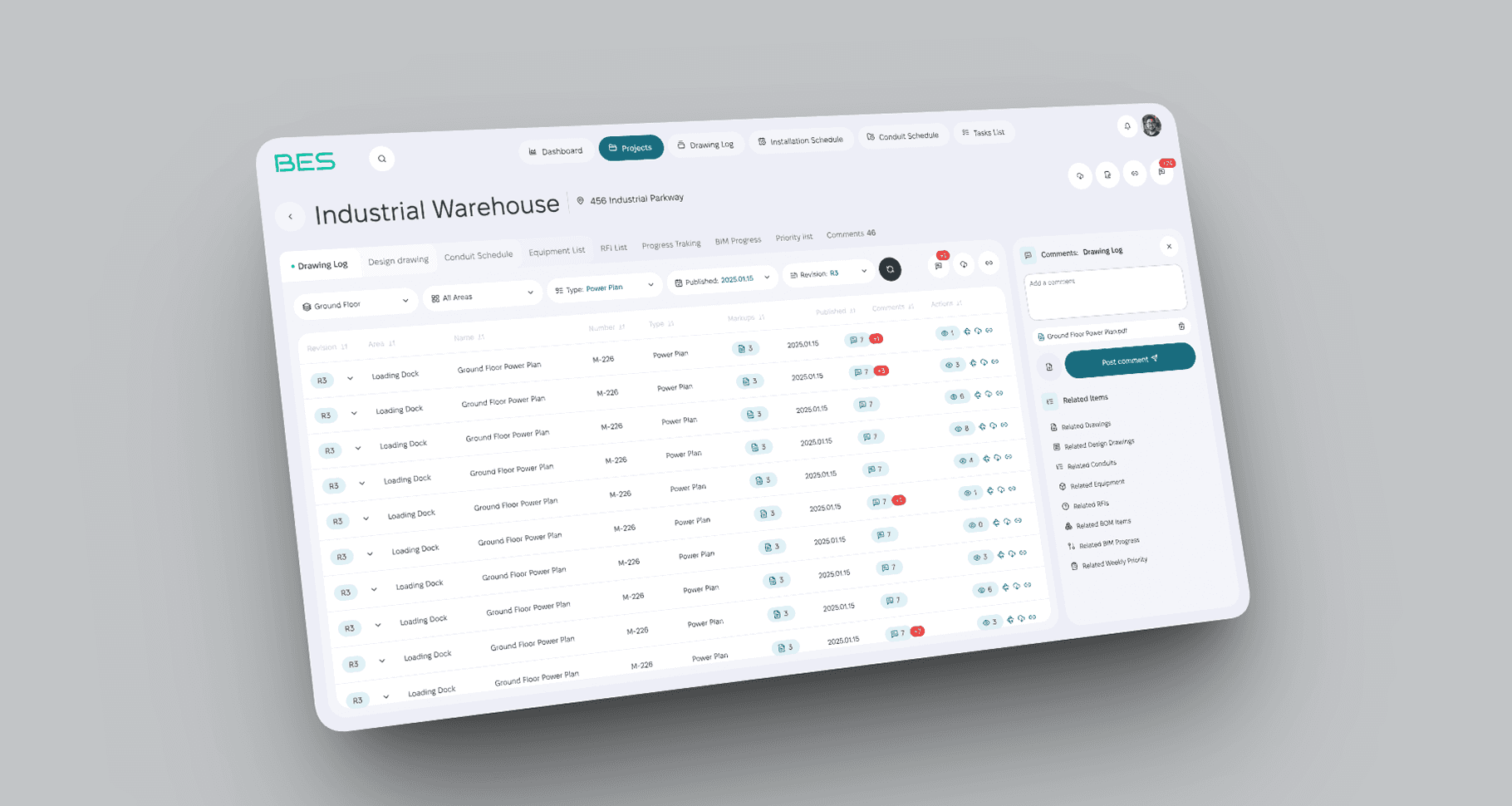
A digital platform for managing construction and engineering projects, documentation and drawings.
BES Tracker

The client

BES Tracker

Industry - Construction Tech
Location - USA

Services

Product Discovery
UX/UI Design
Web Application Development
Data Architecture
Third-party Integrations
BIM/Revit Integration Research
AI Functionality
QA
Deployment

Technology Stack

Next.js - stack technology Malevich company
React - stack technology Malevich company
Typescript - stack technology Malevich company
Node.js - stack technology Malevich company
Nest.js - stack technology Malevich company
PostgreSQL - stack technology Malevich company
Redis - stack technology Malevich company

The Challenge

01.
Create a scalable platform that centralizes technical information for construction projects and replaces scattered drawings, Google Sheets, PDFs, and office/field communication with a single interface. Enable users to move quickly from project → building → floor → zone, access only relevant drawings, equipment, and technical tables, review linked information, add comments or markups, and see the latest status without manually searching across multiple sources.
The SolutionThe Solution

Built a centralized workspace where construction teams can manage drawings, technical tables, equipment, tasks, files, and comments in one place. Implemented hierarchical navigation from building → floor → zone, so users see only the drawings and data relevant to the selected area.

Added drawing revision history, markup uploads, linked materials, public sharing, and connections between drawings, equipment, files, tasks, and technical data. Integrated information from Google Sheets, Revit, Bluebeam, and manual uploads while preserving change history.

Enabled office/field communication through comments, photos, transcribed voice messages, statuses, and daily notifications. Added offline drawing access, Weekly Priority Lists, role-based permissions, and AI-powered data quality checks for duplicates, missing parameters, inconsistencies, and suspicious bulk changes.


Technologies:

Next.js + React

Enabled the development of a complex interactive interface with large volumes of tables, drawings, filters, and interconnected project data while maintaining responsive system performance.
0105

Next.js + React

Enabled the development of a complex interactive interface with large volumes of tables, drawings, filters, and interconnected project data while maintaining responsive system performance.

Node.js

Powered integrations, background processes, notifications, data imports, and file-related operations required across the platform.

PostgreSQL + Redis

Supported reliable handling of large volumes of project data, change history, comments, and asynchronous tasks.

Custom Architecture

Made it possible to implement project-specific relationship logic, revision management, role-based access, offline mode, and BIM/field workflows without the limitations of ready-made platforms.

Google Cloud Platform

Provided centralized deployment for platform services, infrastructure scaling as projects grew, and secure handling of large volumes of drawings, technical data, and files.
BES Tracker

The Outcome

01.

Centralized Project Workspace

BES Tracker brought drawings, technical tables, equipment, tasks, and communication into one platform, combining data from Revit, Google Sheets, Bluebeam, and other sources.

0103
01.

Centralized Project Workspace

BES Tracker brought drawings, technical tables, equipment, tasks, and communication into one platform, combining data from Revit, Google Sheets, Bluebeam, and other sources.

02.

Faster Access to Accurate Information

Office and field teams can quickly find current data, work with the correct drawing revisions, and resolve project issues without constantly switching between multiple systems.

03.

More Reliable and Scalable Workflows

Relationships, version history, comments, markup files, offline access, and AI-powered data quality checks help reduce the risk of using outdated or incorrect information while creating a scalable foundation for further digitalization of construction processes.